For most of this century the obituary of first class was being written in the trade press. Business class had become so good, the argument ran, that the cabin in the nose no longer made sense; airlines were quietly ripping it out, and the golden age of glamorous flight — the one our grandparents dressed up for — was finally, definitively over. The argument was wrong. First class did not die. It went the other way entirely: smaller, more private, more extravagant, and more impossible to get than it has been in a generation.
What happened is one of the more interesting reversals in modern travel, and it tells you something about how luxury behaves under pressure. Faced with a business cabin that had genuinely caught up — flat beds, direct aisle access, fine food — the airlines that kept first class did not compete on the old terms. They redefined the product entirely, turning the front of the aircraft from "a bigger seat" into something closer to a private room with a door, a wardrobe, a separate bed, and a level of service that has more in common with a grand hotel than with anything most people associate with flying.
The transformationFrom seat to suite
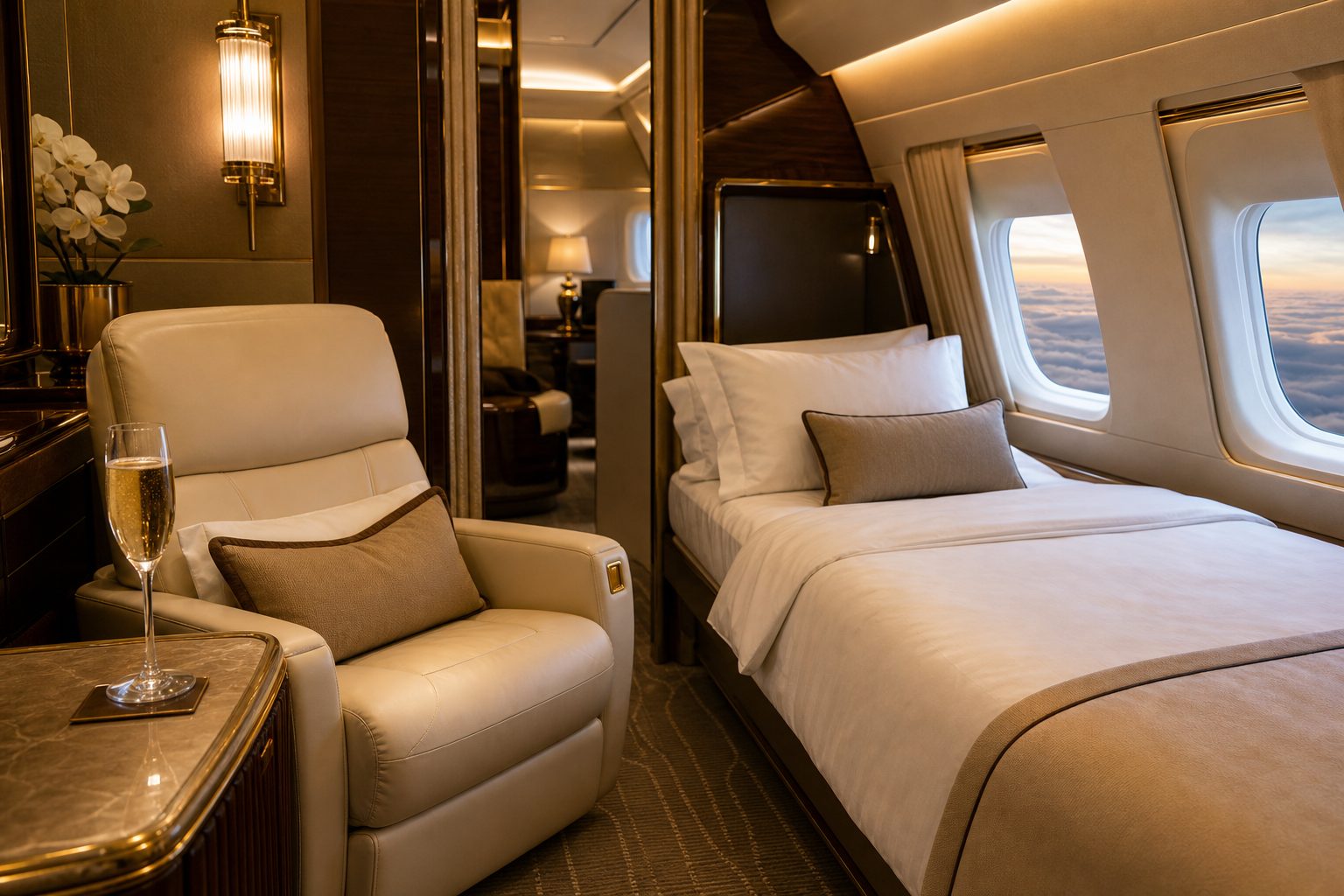
The decisive move was the door. The leading first-class products are no longer seats at all in the conventional sense; they are enclosed suites, with walls high enough and a sliding door solid enough that, once closed, you genuinely forget you are on an aircraft surrounded by strangers. Inside, the vocabulary is domestic rather than aeronautical: a proper armchair, a separate full-length bed made up with real linen and a mattress topper, a wardrobe for your clothes, a vanity, a personal minibar, a wide table that sets for a meal rather than balancing a tray.
A handful of carriers have gone further still, into territory that sounds invented: suites with closing doors and a private double bed, an onboard shower spa at forty thousand feet, a lounge bar you can stand at and a chauffeur waiting at both ends. The point of all this is not merely comfort — business class is already comfortable. The point is transformation: to make the journey itself a destination, a span of hours you arrive looking forward to rather than enduring. That is a different product from a good seat, and it is why first class refused to die.
The leading cabins are no longer seats. They are private rooms that happen to be travelling at the speed of sound.
The experienceWhat you are actually buying
Strip away the marketing and the value of modern first class concentrates in a few things that genuinely matter on a long flight. The first is sleep: a real bed, made up by a crew member while you change, in a cabin of a dozen seats rather than forty, is the difference between arriving wrecked and arriving ready. For anyone flying to do something on the other end — a meeting, an event, a wedding — that alone can justify the fare, because it effectively gives you back a day you would otherwise have lost to recovery.
The second is the ground experience, which the obituary-writers always underrate. The finest first-class products begin long before the gate: a private check-in, a dedicated security channel, a first-class lounge that is itself a destination — proper restaurants, spas, quiet rooms, sometimes a chauffeured drive directly to the aircraft steps. The cumulative effect is the removal of every friction that makes air travel miserable. You do not queue, you are not herded, you are not processed. You are, from curb to cabin, looked after.
The currency that changes the maths
It would be dishonest to discuss first class without addressing the obvious: at face value, the fares are extraordinary, often multiples of business class for gains that are real but incremental. This is why a large share of those turning left at the door did not pay the cash price at all. The single most useful thing to understand about first class is that it is, more than almost any other luxury, accessible through airline loyalty currencies — that the "price" in points can represent a fraction of the cash fare, and that the game of accumulating and spending those points well is what puts the suite within reach of people who would never write the cheque. We will not pretend that game is simple, but it is the lens through which the savvy actually fly up front.
Flying up front, sensibly
- Pick the flight for the bed, not the badge. First-class products vary enormously between airlines and even aircraft types. Research the specific cabin on your specific route; the difference between the best and the merely good is vast.
- Weigh it against recovery. On an overnight long-haul before something that matters, the value is highest. On a daytime hop, business class often makes more sense.
- Learn the points, not just the price. The cash fare is rarely how seasoned flyers get there. Understanding airline and transferable-points currencies is the real key to the front cabin.
- Don't overlook the ground. The private terminal, lounge and chauffeur are a large part of the value; factor them in when comparing products.
- Mind that it's vanishing on some routes. Many airlines now offer first only on flagship aircraft and routes. If it matters to you, it may dictate which flight you choose.
The reckoningComfort and conscience
There is no avoiding the environmental arithmetic, and it is starker here than almost anywhere in travel: a first-class seat occupies far more of the aircraft's floor, and therefore far more of its emissions, than an economy one. To fly up front is to take a larger share of a flight's footprint, and honesty requires sitting with that rather than waving it away. Our own view is consistent with the rest of this journal: that the answer is to fly less often and more deliberately, to favour the newest and most efficient aircraft, and to treat the front cabin as an occasional, considered indulgence rather than a default.
We are also wary of pretending that any of this is necessary. First class is, definitionally, a want rather than a need — a way of converting money or hard-won points into comfort, time and a certain romance. There is no shame in that, but there is no virtue in dressing it up as anything else. The clear-eyed traveller enjoys the suite for exactly what it is: a beautiful, extravagant, occasionally justifiable pleasure, taken knowingly.
First class is a want, never a need — a beautiful indulgence, best taken occasionally and knowingly.
The verdictThe romance survives
Step into one of the great first-class suites — door closed, bed turned down, a glass of something cold to hand and the lights of a continent sliding past the window — and the old promise of air travel, the one that supposedly died, turns out to be very much alive. Flight can still be glamorous; it can still feel like an event rather than an ordeal. The golden age did not end. It simply moved behind a door, became rarer and quieter, and waited for those willing to find the way in.
Whether that is worth it is, properly, a personal question, weighed against both the cost and the conscience. But for the long overnight to the other side of the world, taken occasionally and arranged cleverly, the modern first-class cabin offers something genuinely rare in travel: a journey you look back on with as much pleasure as the destination. The suite, it turns out, was never really about the seat. It was about arriving with the day, and the romance, intact.